History of the Fort

From its origins to the present day

The fortified belt of Liège

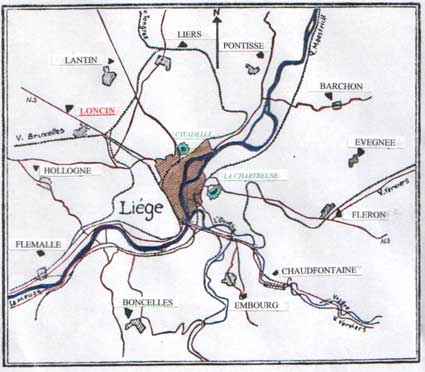
Fort de Loncin is part of the fortified belt of Liège, built in 1888 by General Brialmont. The fortified position of Liège comprises 12 forts:

    • Boncelle
    • Fléron
    • Barchon
    • Pontisse
    • Loncin
    • Flémalle
    • Embourg
    • Chaudfontaine
    • Evegnée
    • Liers
    • Lantin
    • Hollogne
  • Plus 2 older fortresses, “La Citadelle” and “La Chartreuse”

The 12 forts were built in 3 years. They are of the semi-buried type, in unreinforced concrete and triangular in shape, except for Flémalle, Pontisse, Embourg and Chaudfontaine, which are trapezoidal.

Located to the south-west of Liège, about 6,350 m from the city centre, Loncin occupied a strategic position, since its guns commanded the approaches to Brussels along national road 3 and the railway, line 36 Liège/Brussels. In August 1914 the fort’s garrison numbered 550 men: 350 gunners (9th Battery) and 200 infantrymen (14th Line Regiment). The fort was commanded by Commandant NAESSENS, assisted by Lieutenant Modard for the artillery and Lieutenant Remy for the infantry.

The Battle

On 4 August, as the German invasion began, the soldiers in the fort’s curtain wall made a terrible oath to their commander: We shall never surrender

…We swear it…

And that oath was kept.

Brought into action from 7 August and turned into the headquarters of General Leman, governor of the Liège fortress, the fort endured eight days of shelling (15,000 shells) and became the nemesis of the German troops.
To overcome it, the German war machine brought into action a weapon unknown at the time: a 420 mm howitzer, “Big Bertha”, capable of firing shells of about 900 kg.

On 15 August 1914, at about 17:20, the 25th 420 mm shell smashed through the vault of the right-hand powder magazine, which still held 12,000 kg of powder, and caused the fort to explode, killing 350 men. These 350 heroes still lie in the glorious ruins of Fort de Loncin, which became their tomb.

The Last Hours of Fort de Loncin

Here is the moving account of the last hours of the Fort de Loncin garrison, written shortly after the events by the officer in charge of the fort, Colonel Naessens:

Written in the blood of the soldiers of Fort de Loncin, this day is one of the finest pages in the history of the war.

At about 1 o’clock in the morning, a shell smashed the armour of the gun chamber flanking the entrance postern, tore the gunner on duty apart and set off a large part of the ammunition.

From 1:30 a.m. we were plunged into darkness for the first time, for two hours: the chimney of the steam generator filled with debris, which shut down the electrical installations until it could be cleared.

But nothing weakened the garrison’s morale. By the end of the night the fort was already seriously damaged. I gave orders for certain clearing and repair work to be carried out outside, but it was impossible to undertake anything of the kind, so heavy was the rain of shells.

At dawn the bombardment redoubled in violence.

We continued to return fire vigorously on the batteries located the day before.

Shells fell in salvoes from every direction: Liège, Ans, Alleur, Loncin, Liers, Xhendremael, Hognoul, Fooz.

Picture, if you can, the appearance of our fort, isolated in the vast empty plain, the meeting point of all these formidable shells rushing in with dreadful howls from every point of the horizon and bursting, with a terrifying crash, amid flames and greenish smoke.

Soon the fort filled with acrid, opaque smoke; often one could not see 10 centimetres ahead. The men breathed through their clothing and handkerchiefs to avoid suffocation. Every attempt to stop the gas from entering failed.

Meanwhile, work went on without pause: the cupolas jammed by enemy fire were put back into working order; buckets of water were set down all over the fort in case of fire, and so on.

At 10 o’clock there was no longer any electric light or ventilation: the steam generator’s chimney was completely blocked. I ordered it to be cleared at all costs.

It was impossible to light the oil lamps, so violently was the fort shaken by shells exploding on the concrete mass.

Three acetylene lamps, the only light we had left, burning in our last shelters (the central gallery and the capital gallery), went out each time a heavy shell struck the concrete mass. But men relit them tirelessly and, by the glow of these lanterns, a glow greatly dimmed by the smoke and dust that made the air almost opaque, our soldiers, at rest, played cards, sitting on empty ammunition boxes.

At noon, a brief lull.

At 14:00 the bombardment was at its height.

At about 15:00 the bombardment grew still more intense. Absolutely convinced that the enemy would soon send its infantry against the fort, I announced that an assault could be expected before evening or, at the latest, at daybreak the next morning.

There was, at once, a genuine outburst of joy.

Everyone was joking and yet they knew they were going to die.

But they thought they would fall in a frantic face-to-face fight, in a furious hand-to-hand struggle. They were not granted that, the brave lads.

The 42 cm shells were to clear the way conveniently for the German rabble, as at Vaux and at Douaumont, at no cost to its infantry.

It will be the lasting regret of every survivor to have missed that feast of the assault, which they had promised themselves they would make so fine.

At 16:00 an officer reported that, during the brief lull that had just occurred, he had seen in a ditch a monstrous unexploded shell, as tall as himself and of enormous calibre: it was a 42 cm shell.

At about 17:00 the bombardment became appalling. A few minutes later I saw an immense flame and I lost consciousness.

The powder magazine, pierced by a 42 cm shell, had just blown up.

Under the tremendous thrust of the gases from the blast, under the force of that titanic volcano, what remained of the concrete mass was torn apart and a large part of the garrison was crushed beneath blocks of concrete, suffocated or burned alive.

Every survivor was also out of action: not one was unhurt.

After the explosion the bombardment continued for some time, then the “victors” cautiously entered that heap of ruins, which still filled them with dread.

Then there unfolded a sublime scene that deserves to be remembered by posterity.

A handful of wounded and burned men, trapped between blocks of concrete and still holding rifles or carbines, opened fire on the Germans as they approached.

They no longer looked human; their faces entirely black, their features distorted by hatred and suffering, they were dreadful to behold.

Hoarse cries of “Long live Belgium!” came from their bruised chests. They shot down the first enemy soldier who planted the German flag on the ruins of the fort.

The most determined of them had a leg crushed under an enormous block; it had to be cut off to free him.

The Germans, stunned by this sublime heroism, committed no violence. They uncovered their heads as the wounded and the burned were carried past.

COLONEL NAESSENS.
August 1914 – November 1918: occupation of the fort by the German army

As soon as Fort de Loncin fell, the German army occupied the fort and, as far as possible, set about rearming it so as to be able to meet a possible counter-offensive by the British and/or French armies.

The Germans also walled up various rooms that posed problems of stability, safety or hygiene. Some rooms close to the central mass contained a large quantity of unexploded ammunition, mixed with the human remains of the garrison’s soldiers.

Finally, given the striking scale of the destruction and in order to demonstrate the power of their artillery, the Germans took countless photographs of the fort’s ruins and used them, from August 1914 onwards, for propaganda. This propaganda bore fruit: it was one of the main reasons for the dismantling of the artillery of the forts in the Verdun region.

December 1918 – 1968: the era of the Legrand family

After the German army left, the fort was abandoned. Because of the fort’s defenders killed in the explosion, most of whom still lie beneath its ruins, the fort stood in the eyes of the world as the symbol of little Belgium’s heroism in the face of the German ogre.

The fort, however, was open to the four winds. Its entrance gate had been torn away in the explosion of August 1914, and numerous cracks allowed the most daring to venture into the very sanctuary where the soldiers lay in their last sleep. Some scrap dealers, greedy for the copper of the electrical installations and the various metals the fort contained, did not hesitate to help themselves.

In view of this situation, the army set about finding a caretaker for Fort de Loncin. The caretaker would have to live in the fort and occupy a barrack room assigned to him.

There were few candidates, for at that time the fort stood isolated in the countryside. It no longer had electricity, the well that held the drinking water was no longer accessible, water ran through the many cracks in the ceilings caused by the explosion, and living there was akin to living in the middle of a cemetery.

And yet there was a volunteer: Private Nicolas Legrand, accompanied by his young wife of 19, Désirée Preudhomme, and their baby, then nine months old, Pierre. Nicolas Legrand wanted the post because he was one of the survivors of the fort’s explosion, where he had served as a gunner. He was also a disabled war veteran, having suffered a burst lung in the explosion of August 1914.

Mr and Mrs Legrand took up their duties on 1 January 1920. They lived in the fort until 1932, the year they were able to live somewhere other than the fort.

During their long years at Fort de Loncin, Mr and Mrs Legrand witnessed many events. They were there in April 1921, when the military graves service exhumed the servicemen buried by the Germans on the fort’s glacis and inside the fort. That exhumation led to the upper floor of the head coffer being turned into a crypt. The remains of 43 servicemen were laid there.

Mr Legrand died in 1952. His wife continued her work as caretaker, which in her memoirs she compares to a sacred calling, until 1968, when she took a well-earned retirement.

The 1970s: disaster and the promise of better days

This decade was both disastrous for Fort de Loncin and a source of hope for the future. In July 1968, after Mrs Legrand’s departure, a new caretaker was appointed. He did his best with the limited means granted to him for the upkeep of the fort — that is to say, almost nothing.

It was during the first half of the 1970s that regrettable events took place. Taking advantage of the caretaker’s naivety and credulity, an unscrupulous individual managed to convince him that he was authorised to search the ruins. That person was later, fortunately, tried and convicted of grave violation, first by the criminal court and then by the Court of Appeal.

It was in the wake of these unfortunate events that some people at last grew concerned about the state of the Fort de Loncin necropolis, which had not only been looted but had also become a dumping ground.

From 1980 to the present day

Through the work of the volunteers of the Front de sauvegarde du Fort de Loncin, the appearance of Fort de Loncin changed quickly. The central mass was cleared of undergrowth, and the gorge ditch and the flank ditches were cleaned. Seeing the efforts of these courageous people, the State Buildings Agency (Régie des Bâtiments), owner of the site, built a caretaker’s lodge and a museum, and carried out various works to make the fort easier for visitors to enter. Finally, as a crowning touch, a new building was constructed on the former glacis to house a Museum, inaugurated on 8 December 1996, which admirably completes the work achieved by all the volunteers over the previous 20 years.

With an infrastructure at last worthy of the name, the non-profit association “Le Front de Sauvegarde du Fort de Loncin” regularly organises guided tours recalling that here, on a fine summer’s day, 550 soldiers, most of them about twenty years old, resolved to sacrifice their lives if need be in order to defend the freedom and the democracy that are ours today.

Finally, since 2006, Fort de Loncin has had a memorial interpretive trail that allows visitors to relive the last days of the fort’s garrison in August 1914. After an introduction at the start of the visit, the visitor is plunged into the fighting at Fort de Loncin by means of a realistic sound reconstruction of the garrison’s life under bombardment, ending with the fort’s final explosion. After seeing the crater caused by the explosion of the powder magazine and visiting the crypt, the visitor ends the tour by discovering various displays intended to prompt reflection on the absurdity of war, the folly of humankind and the virtues of peace.

Partners